For engineering leaders
Your pipeline was built for humans. Your team isn’t only human anymore.
Bolting AI onto the Git workflow and CI/CD you designed for people is why your agents feel fast and your delivery doesn’t. The fix isn’t a better plugin. It’s rebuilding the process from first principles for how AI actually works — with you in the driver’s seat.
Human-steered · 100% AI throughput · nothing to self-host
The bolt-on trap
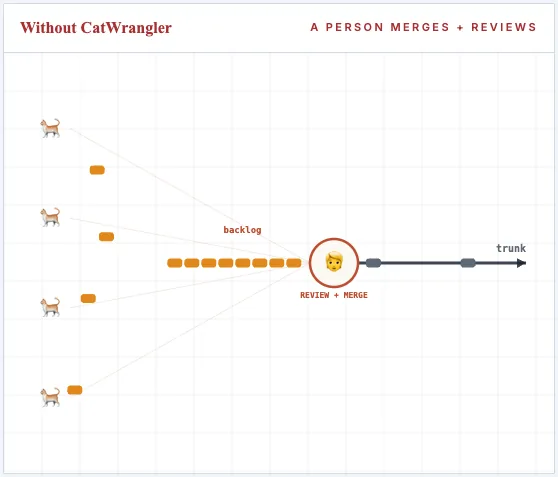
A worktree per agent keeps them out of each other’s way — until the work comes back together.
Isolation isn’t the hard part anymore: every agent gets its own Git worktree so they don’t clobber each other mid-flight. But in a real codebase, two agents on completely unrelated tasks will still, sooner or later, need the same file or the same function. That overlap is incidental — no amount of up-front design prevents it. It just surfaces at the end, as a merge conflict.
And then it all lands on one person: resolving conflicts by hand and reverse-engineering why each agent did what it did, because none of that reasoning was written down. You bought AI speed and funneled it into a single human-speed reckoning — and made a person the slowest part.
First principles
The scarce thing changed. The pipeline didn’t.
Your workflow was optimized for the expensive resource of its era — human coding time. Agents made code cheap. Now the scarce, durable assets are coherence and intent. Optimize for those instead.
Optimized for — the old scarcity
Human coding time
Weeks of design thinking, mockups, requirements, tradeoff meetings — all to make the expensive, hard-to-reverse decisions correctly before anyone touched a keyboard. The right call, when writing the code was the slow part.
Optimize for — the new scarcity
Coherence & intent
Let the machine coordinate and build at machine speed. Capture the reasoning behind every change as it happens. Keep a person steering direction — a partner behind the wheel, not a bottleneck in the queue.
The context layer
Your agents don’t need a bigger model. They need to understand your system.
In a real codebase an agent has to know where things live, what already exists, and why it’s built the way it is — or it thrashes, re-derives, and rebuilds something you already have. CatWrangler is that context layer for your code: every decision and its reasoning, captured and connected. Any agent — or you — can ask “where does this live, and why,” get a straight answer, and land the change in the right place.
And because a decision is filed the moment it’s made — before a line of code is written — an agent also sees what’s already built and what’s being built right now, so two agents don’t quietly write the same login page twice. It’s real leverage even with a single agent.
The analysts are converging on the same idea: Gartner calls the context layer “foundational for AI success,” and expects the teams that prioritize it to pull well ahead on accuracy and cost.
The real loss
Now decisions happen at the speed of thought. So does forgetting them.
A human talks to an agent, discovers a solution, a new direction — and implements it almost instantly. Then the next choice. Then the next. You’re holding the whole model in your head in the moment, getting it right, feeling good about it, and moving on. And you will not remember it a day later. Hours later, maybe not. Your agent won’t either — it’s reset ten times since.
The old ceremonies were the slot where the why got written down. Delete the ceremonies — as AI speed forces you to — and there’s no slot left. Without a system for it, you don’t lose the reasoning to laziness. You lose it to speed.
What we actually wanted all along
The point was never the docs. It was seeing the feature.
Every requirements doc and mockup was a proxy for the thing product, sales, and leadership were actually hungry for: seeing features work — watching real people use a new idea, in the product, for real. We built the paperwork because we couldn’t build the feature fast enough to just look at it.
Now you can. So fast it makes your head spin. The most efficient process in a world of near-zero-cost code is a human who knows the space, working with an AI, feature by feature — building it, seeing it live, playing with it in context, changing it, testing it for real. You’ll want new regimes for testing and understanding usage. But who goes back to a one-week sprint when a week of features takes an hour?
Not just “write more specs”
Everyone agrees the process must change. Most are betting on more documents.
The popular answer is spec-driven development: make the spec the source of truth and treat code as the “last mile.” Writing a spec is fine — a great way to start an agent. But making a document the thing you maintain is the old ceremony in new clothes: agents moving at speed outrun it, and the answer to the lost why becomes more markdown — architecture docs, decision records, an AGENTS.md — sitting next to the system with no idea whether it’s still true.
You already built that framework — the SDDs, the “how we do it here.” Who reminds whom to update it? And how do you know what’s actually in the code from a ten-page doc?
The incidental collisions
Unrelated work still collides. A person untangling it is the bottleneck.
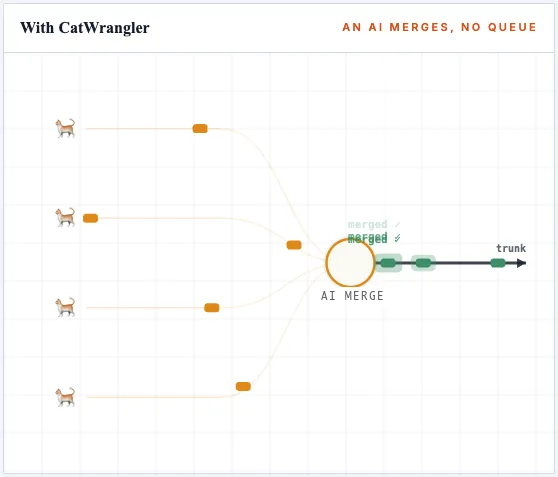
Even with a shared context layer, two agents on different tasks will incidentally touch the same file — that part is unavoidable. Without CatWrangler a person untangles those merges and reviews every one, so trunk crawls. With CatWrangler an AI resolves them at machine speed, and trunk keeps pace with the agents.
Illustrative, not a benchmark — both ship to trunk; the difference is what sits in the middle.
The process itself
The old lifecycle, with agents bolted in — versus building for real.
The bolt-on lifecycle
- 1Gather requirements; conceptualize the whole build; write the docs.
- 2Break into features; mockups; walkthroughs that don’t quite work. More docs — and more is just more to lose track of.
- 3Meet with tech on what’s buildable; write implementation docs.
- 4Parcel out the work — carefully, so agents don’t step on each other.
- 5Build at AI speed. Mid-build you hit a choice. Then another. Then another. Keep going.
- 6Merge it all together — and no one remembers why that first choice was made, or that a choice was even faced. Move on.
The AI-native way
…and you remember all of it — the why, captured with the code.
What AI-native actually gives you
Speed the machine can use, control you keep.
Governance
A living audit trail, for free
Every decision is captured with its reasoning and the alternatives ruled out — a queryable record of why the system is the way it is. Onboarding, review, and “why is this like this” answer themselves.
Control
100% AI. 100% you, steering.
Authority stays with the humans. Agents act at every decision point; you direct. Going all-in on AI doesn’t mean hands off the wheel — it means you stop being the bottleneck.
Coordination
A line per agent, incidental collisions handled
Every agent gets its own line of work the instant it writes. The incidental overlaps concurrency creates — unrelated work touching the same file — are resolved at merge by an AI, anywhere in a file, never silently overwritten. No queue, no stomping.
Adoption
Hand it a spec and go
Point your team’s agents at it and start building. Hand an agent your first spec and let it start — and the decision tree’s roots are planted. From there it moves at AI speed. Hosted, not another system to run. And any time you want your code, just export it back out.
The receipts
You don’t have to take our word for the problem.
First, the field’s own numbers on what happens when you bolt AI onto a human pipeline.
// Sources: 2025 DORA report & Faros AI · METR RCT (2025) · CodeRabbit / GitClear (2025–26). “AI is an amplifier — it doesn’t fix a team, it amplifies what’s already there.” — DORA
Then, our own: the same product, built with and without CatWrangler.
▼ 37% cheaper on this build
What drove it: agents stopped stomping each other — and stopped burning a second wave of tokens fixing the bugs a bad merge introduces. Then a five-way convergence on one file: a “power-ups” feature forced a single-ball → multi-ball refactor that had to interlock with three other agents’ work already in the same file. The resolver auto-merged all of it, live, with zero conflict markers.
Real numbers from repeated head-to-head builds — the ranges have held steady across many runs, and we keep improving. We report specific runs, not a guaranteed average.
“But I can’t just throw out my process”
You don’t rip and replace. You start one project and measure it.
“I have a real codebase, not a greenfield.”
Bring it in — point CatWrangler at your repo in one shot, no lock-in. Real version control runs underneath, and you can export back out any time.
“I need control and an audit trail.”
You keep authority, and the decision graph is the audit trail — every change traceable to the reasoning behind it, queryable in plain English.
“Going all-in on AI is a big bet.”
So don’t bet the org. Run one team on one project head-to-head against your current way, and read the bill. We build the same product both ways, and it keeps coming out cheaper.
Go deeper
The essay
Stop bolting AI onto a human pipeline
The first-principles case for why the merge desk is your bottleneck.
Read it →See it
What goes wrong — and what doesn’t
Two short illustrated stories of collisions caught before they land.
See it →The walkthrough
How CatWrangler works, in five steps
From sign-up to shipping in a few minutes — nothing to learn.
How it works →For engineering leaders
Stop retrofitting. Build for the team you actually have.
A handful of humans, a swarm of agents, one coherent codebase — coordinated by the machine, steered by you.